
Your pricing model was built for humans. Your next buyer might not be one.

Updated: May 5
If you’re running a SaaS company with seat-based pricing, here’s a question you may have asked yourself: what happens when the “user” is an AI agent, not a person?
Maybe you dismissed it. “Great thought experiment, but I’m living in the real world until that far-off expiration date comes.” A lot of players have already made their moves. Zendesk for instance has shifted to pricing their AI agent product based on resolved tickets rather than human seats. (Jamin Ball wrote about this in greater detail in Clouded Judgement. Highly recommend the read.)
It seemed like a distant future, but AI agents are already interacting with software the way humans used to. Pulling data, triggering workflows and executing decisions. The interface becomes irrelevant. The database underneath becomes everything.
GTM Implications
Seat-based pricing wasn’t built for users who don’t have a pulse. In order to plan for what's next, we need to look not just at pricing, but at Go-To-Market more broadly.
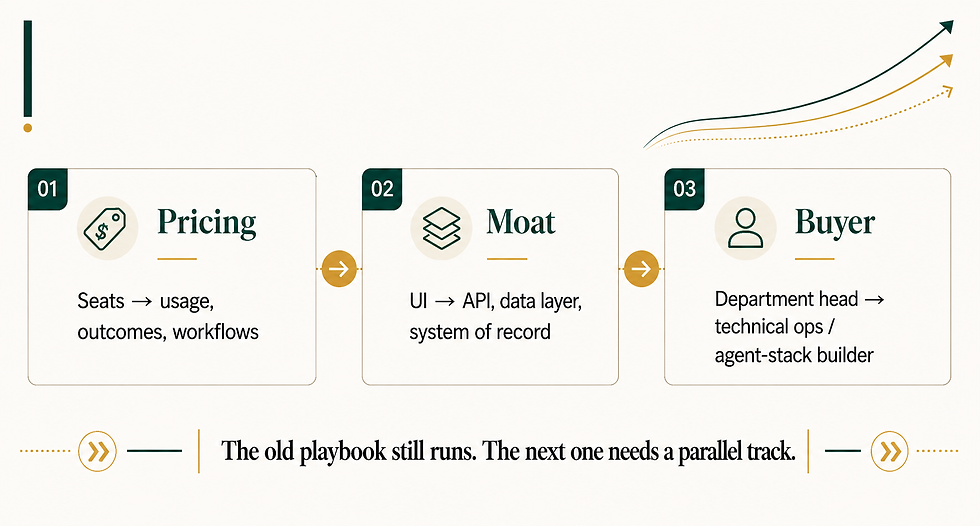
1. Value Metrics Need to Shift
If agents can do in seconds what took a team of five all week, charging per seat is leaving money on the table, and more often than not, incentivizing customers to consolidate licenses. Usage-based or outcome-based pricing starts to make a lot more sense when the “work” is decoupled from the “worker.”
2. Your Competitive Moat Changes
When agents bypass the UI entirely, product design and user experience stop being differentiators. What matters is your data layer, are you the system of record that agents can’t route around? (Nicola Ayan at Optimizely has a great LinkedIn post about us forgetting, amidst AI hype, that the business layer not the UI is the brain of the application).
3. Your ICP May Be Evolving Without You Noticing
The person evaluating your tool might not be a department head anymore. It might be a technical team building an agent stack. Is your GTM motion set up to reach them? If your entire funnel is optimized for a VP of Ops doing a demo, you could be invisible to the buyer who actually holds budget.
Things SaaS Companies Can Do Today
You don’t need to blow up your pricing page tomorrow. In fact, you may need the old playbook to run for quite some time.
But it is time to start hedging. There are a few actions I’ve observed companies take that you can start on today to get in a better position when you DO need to make a shift.
1. Audit Your Value Metric
Ask yourself: if every human user on this account were replaced by an AI agent tomorrow, would our pricing still capture value? If the answer is no (or even “probably not”), start modeling alternative metrics. Examples include: outcomes delivered, data processed, workflows completed, decisions made. You don’t have to ship a new pricing model next quarter, but you should understand what one could look like.
2. Invest in Your API and Data Layer
If agents are the future buyers (or at least the future users), they’re not going to care about your gorgeous onboarding flow. I know, this stings for me, I’ve built quite a few. They care about clean APIs, well-documented endpoints and reliable data. Start thinking about your product’s developer experience with the same seriousness you bring to your UI. The companies that become the system of record for agent workflows will have massive structural advantages.
3. Map Your ICP Expansion
Your champion used to be a department head who saw a demo and fell in love with the product. In this paralell track we're talking about, your champion might be a solutions architect or a technical ops lead building an agent stack. Take a hard look at the target personas list and ask: are we reaching the people who are making infrastructure-level decisions about how agents interact with tools? If not, your content, your outbound and your event strategy may need a parallel track. Ask your CS team if there is a customer who is deploying agents to utilize software. They may have the best intel on how to map this and which new personas are now involved.
4. Run a “What If” Pricing Scenario
Get your finance and product teams together and model this: if 30% of your seats converted to agent-driven usage within 18 months, what happens to ARR? What happens to expansion revenue? What happens to your NRR story? You DO NOT need perfect inputs for this, the exercise itself will surface assumptions you didn’t know you were making.
5. Watch What the Platform Players Are Doing
Zendesk’s move to resolved-ticket pricing isn’t an anomaly. Pay attention to how the bigger players in your space are repositioning. When platforms start pricing for outcomes rather than access, it creates gravitational pull across the category. If a competitor moves first, you’ll want to have a response ready, not be scrambling to figure out what your own usage data looks like.
The Playbook Isn’t Broken. But It Needs a Parallel Track.
The SaaS playbook we’ve all been running—land a champion, expand seats, grow into the org—assumed humans were the end users. That playbook still needs to run. But in parallel with something new. Not because the old one is broken today, but because by the time it is, you’ll want the new one tested.
The companies that start thinking about this now, even imperfectly, even just as a quarterly exercise, will likely be the ones with options when the market shifts. The ones that don’t will be the ones explaining to their board why NRR imploded and nobody saw it coming.
A big caveat: there are industries where this is a very, very, verrrrry long way off. I have one client whose ICP is barely using spreadsheets to manage customer data, let alone agentically accessing software systems. So for some of you, the runway may be long. But for many if not most, it’s time to start reimagining your pricing and positioning for a world where agents do the buying.
Are you thinking about this already? I’d love to hear what adjustments you’ve made and what principles are guiding your thinking. Drop me a line or find me on LinkedIn.



Comments